

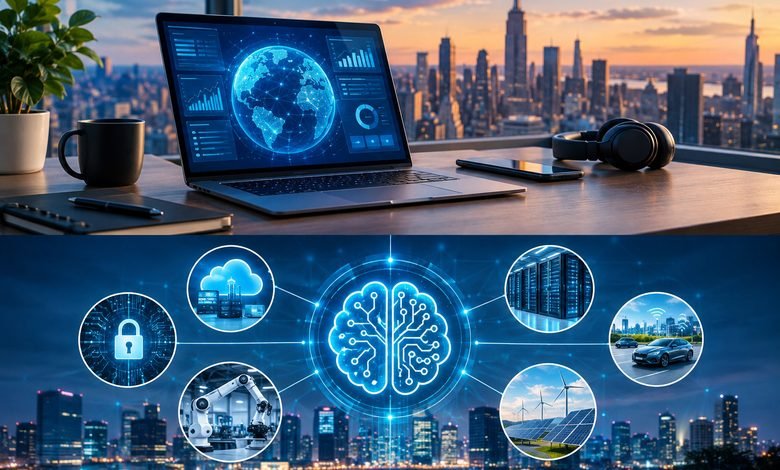
Technology in the United States is changing very quickly. Artificial intelligence, cloud computing, cybersecurity, automation, semiconductors, and data centers are now major parts of the technology market. Droven.io USA Tech Market Updates can be viewed as a useful topic for understanding these changes in simple terms. The focus is not only on new products but also on how technology affects businesses, workers, investors, and everyday digital life. Recent market activity also shows that AI investment remains powerful, while questions about safety, infrastructure, costs, and regulation are becoming more important.
How Droven.io USA Tech Market Updates Relate to the U.S. Technology Market
Droven.io is described by recent third-party coverage as an editorial technology information platform, rather than a software product or SaaS service. Its reported subject areas include AI, automation, cybersecurity, cloud computing, and other technology topics. This makes the keyword useful for readers who want a simple way to explore broad technology developments instead of focusing on one company or one product.
For readers, the main value is understanding the connection between different technologies. AI needs powerful chips and cloud infrastructure. Cloud systems need strong cybersecurity. Automation needs reliable software and data. Looking at these areas together gives a clearer picture of where the U.S. technology market may move next.
How Artificial Intelligence Is Shaping Future U.S. Technology
Artificial intelligence remains one of the strongest forces in the technology market. Businesses are using AI for software development, customer support, research, data analysis, content workflows, and automation. The next stage is expected to include more AI agents that can complete connected tasks instead of simply answering individual questions.
However, the market is also becoming more careful about AI. On September 14, 2026, major technology leaders raised concerns about the speed and safety of advanced AI development, contributing to a sharp movement in AI-related stocks. This shows that future technology will depend not only on better models but also on safety, testing, governance, and responsible deployment.
Why AI Automation and Intelligent Agents Matter for Businesses
AI automation can help organizations handle repetitive work faster. Businesses may use intelligent systems to organize information, summarize documents, support customers, monitor processes, or assist employees with technical tasks. This can save time, but companies still need people to check important results.
The future is therefore likely to be a human-and-AI working model rather than complete replacement of people. Workers will need skills such as critical thinking, communication, digital literacy, and the ability to review AI-generated results. Companies that train their teams may be better prepared for changes in the technology market.
How Cloud Computing and Edge Technology Are Evolving
Cloud computing is another major part of the future technology landscape. AI systems need large amounts of computing power, storage, and networking. This is pushing cloud providers and other technology companies to invest heavily in infrastructure and data centers.
Recent market reporting shows how large this investment has become. Oracle, for example, reported a major increase in capital spending and strong growth in its cloud-infrastructure business, driven partly by demand connected to AI.
Edge computing can also become more important as companies need faster processing closer to devices and users. Together, cloud and edge systems can support applications that require speed, scale, and continuous data processing.
The Growing Role of Cybersecurity in Future Technology
As technology becomes more connected, cybersecurity becomes more important. AI can help security teams identify unusual activity, analyze large amounts of data, and respond to threats. At the same time, attackers may also use AI to make cyber threats more advanced.
Recent market activity highlights this growing importance. On September 14, 2026, cybersecurity companies gained while several major AI hardware stocks declined. This movement shows that investors and businesses are paying close attention to digital protection as AI adoption expands.
Businesses should therefore consider security during the design of new systems, not only after a problem occurs. Secure-by-design practices, monitoring, employee training, and recovery planning can all strengthen digital resilience.
How Robotics and Smart Systems Could Transform U.S. Industries
Robotics is another important area to watch. Modern robots can combine sensors, software, computer vision, and AI to perform increasingly complex tasks. Manufacturing, logistics, warehouses, healthcare, and other industries can benefit from smart machines.
The important change is the combination of robotics and artificial intelligence. Traditional automation usually follows fixed instructions, while AI-enabled systems can potentially respond to changing conditions. This could make automation more flexible, although cost, safety, maintenance, and workforce training will remain important challenges.
Why Digital Twins and Connected Technologies Are Gaining Attention
Connected devices create large amounts of information that businesses can use to improve operations. Internet of Things (IoT) systems can monitor equipment, buildings, vehicles, and industrial processes. Digital twins can then create virtual representations of physical systems for analysis and planning.
These technologies can help organizations understand how equipment behaves before making expensive changes. When combined with cloud computing and AI, connected systems can support predictive maintenance, energy management, and more efficient operations.
Read More: epleys.com
How Emerging Technology May Change Jobs, Skills, and Business Operations
Future technology will change the skills that companies need. Some repetitive tasks may become automated, while new roles can develop around AI management, cybersecurity, data analysis, cloud infrastructure, and technology governance.
This means workers should focus on adaptable skills. Learning how to use digital tools, evaluate information, communicate clearly, and solve problems can remain valuable even as specific software changes. Businesses also have a role by providing training instead of expecting employees to adapt without support.
What Future Technology Trends Businesses Should Watch Next
The biggest trends to watch include AI agents, AI infrastructure, cybersecurity, cloud expansion, robotics, automation, advanced chips, and technology regulation. These areas are connected, so a major change in one can affect the others.
The current market also shows why technology trends should be followed with a balanced view. AI investment remains enormous, but investors are increasingly considering safety, costs, regulation, infrastructure requirements, and actual business value. Recent reporting also points to very large AI-related infrastructure spending by major technology companies.
For anyone following Droven.io USA Tech Market Updates, the best approach is to look beyond headlines. Compare new developments, understand their practical effects, and ask whether a technology solves a real problem. Future technology will not be defined by one invention. It will be shaped by how AI, cloud systems, security, automation, hardware, and people work together.
FAQs
What is Droven.io USA Tech Market Updates?
It is an informational topic focused on U.S. technology developments, including AI, cloud computing, cybersecurity, automation, and emerging technologies.
What technology trend is most important in the U.S.?
Artificial intelligence is one of the most important trends, especially in business automation, software, cloud infrastructure, and data processing.
Why is cybersecurity important for future technology?
More connected and AI-powered systems can create new security risks, making strong cybersecurity essential for businesses and users.
Will AI change the future of work?
Yes. AI can automate some repetitive tasks while increasing demand for digital, analytical, creative, and technology-management skills.
What should businesses watch in future technology?
Businesses should monitor AI agents, cloud infrastructure, cybersecurity, robotics, automation, advanced chips, and technology regulation.