

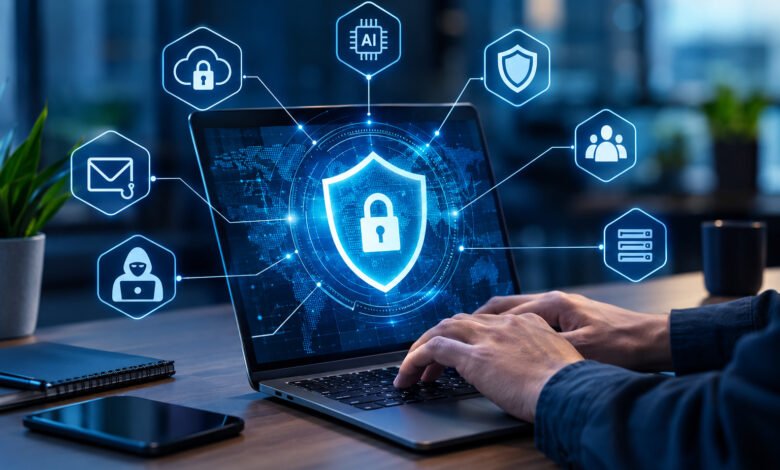
Cybersecurity is changing quickly as businesses move more work to cloud platforms, use artificial intelligence, and connect more devices every day. Droven IO Cybersecurity Updates is commonly used online for educational content about modern security risks, including AI-based attacks, ransomware, cloud security, phishing, Zero Trust, and security automation. Current search results also show that readers should separate original Droven.io material from third-party pages using the same keyword. This guide explains the main security ideas in simple language and shows how businesses can turn them into practical defense strategies.
What Are Droven IO Cybersecurity Updates?
Droven IO Cybersecurity Updates generally refers to cybersecurity information associated with Droven.io. Available material discusses common business security issues such as AI-assisted attacks, ransomware, cloud security, Zero Trust, software updates, and human error. These topics are useful because they help readers understand how modern cyber risks can affect normal business operations.
However, readers should understand an important difference. Current research does not clearly verify Droven.io as a dedicated security product, managed security service, or official real-time vulnerability database. Some recent articles describe it as an informational technology site rather than a security vendor. Therefore, important security claims should be checked against trusted sources such as NIST, CISA, and software vendors.
How Modern Cyber Threats Are Changing
Cyberattacks are no longer limited to simple computer viruses. Criminals can use automation, stolen credentials, social engineering, and artificial intelligence to make attacks faster and more convincing. This means businesses need more than one security tool.
A modern defense plan should protect accounts, devices, applications, networks, cloud services, and data. It should also include regular monitoring and recovery planning. The goal is not to promise perfect security. Instead, organizations should reduce risk, detect problems early, and recover quickly when something goes wrong.
AI-Powered Attacks Need Stronger Defenses
Artificial intelligence is becoming an important part of the cybersecurity discussion. Attackers can use automated tools to create convincing phishing messages, improve social engineering, and speed up parts of their work. At the same time, defenders can use AI to review large amounts of security information and identify unusual behavior.
This creates a new security challenge. Businesses should not use AI simply because it is popular. They should first understand what data an AI tool can access, who can use it, and how sensitive information is handled. Human review remains important when AI supports important security decisions.
Protecting Against Phishing and Ransomware
Phishing remains a major risk because it targets people directly. A fake message may ask a user to open a file, visit a website, confirm an account, or share sensitive information. A strong defense combines employee awareness with technical controls.
Ransomware creates another serious risk by disrupting access to systems or information. Businesses should maintain reliable backups, update important software, use strong authentication, and limit unnecessary account permissions. Backups should also be tested because a backup that cannot be restored is not a dependable recovery solution.
Cloud Security and Zero Trust
Cloud services make it easier for organizations to work from different locations, but they also introduce new security responsibilities. Poor permissions, weak authentication, exposed storage, and incorrect settings can create unnecessary risks.
Zero Trust offers a different approach to access. Instead of automatically trusting users because they are inside a network, organizations verify identity, device status, permissions, and the requested resource. This can reduce the damage caused by compromised accounts and unnecessary access.
Identity and Access Control Matter
Account security is one of the most practical areas for businesses to improve. A stolen password can become a serious problem when an account has access to customer information, cloud systems, or important business tools.
Organizations should use multi-factor authentication (MFA) where possible and apply the principle of least privilege. Employees should receive only the access they need for their jobs. Access should also be reviewed when responsibilities change, and accounts should be disabled when they are no longer required.
Security Automation and Threat Detection
Modern companies can generate thousands of security events. These may come from email systems, cloud platforms, applications, endpoints, networks, and identity services. Manually checking every event can be difficult.
Security automation can help sort alerts and identify unusual activity. However, automation should support skilled people rather than replace them completely. A useful strategy is to let automation handle repetitive tasks while security teams investigate serious events and improve protection based on what they learn.
Software Updates and Vulnerability Management
Software updates are a basic part of cybersecurity. Applications and operating systems can contain security weaknesses, and vendors may release patches to correct them. Businesses need a clear process for finding affected systems and applying important updates.
A good patch process includes identifying vulnerable software, testing important changes, installing patches, and checking that updates worked correctly. Organizations should also maintain an inventory of their important applications and devices. Without knowing what software is being used, it becomes harder to manage security risks.
How Businesses Can Build a Modern Defense Strategy
The strongest approach is layered security. Businesses should begin by identifying important systems and information. They can then protect those assets with strong authentication, access controls, software updates, backups, monitoring, and employee training.
The NIST Cybersecurity Framework 2.0 provides a useful structure built around Govern, Identify, Protect, Detect, Respond, and Recover. It helps organizations think about cybersecurity as an ongoing risk-management process rather than a one-time technical project. NIST also continues to develop guidance about using AI with cybersecurity management.
Read More: epleys.com
How to Check Cybersecurity Information Carefully
Search results for Droven IO Cybersecurity Updates currently include many third-party articles with similar wording and claims. Some sources have questioned the reliability of repeated statistics because they are often published without a clear original reference. This makes source checking especially important.
Before acting on a security claim, check who published it, when it was published, what evidence supports it, and whether a primary source confirms it. For important security decisions, compare information with official advisories, recognized security frameworks, and vendor documentation. This simple habit can help readers avoid confusing general cybersecurity education with an official security alert.
Building Better Security Habits for the Future
Cybersecurity should become part of everyday business activity. Teams can start with simple actions: enable MFA, update software, review permissions, protect backups, train employees, and monitor important accounts. These steps may seem basic, but they create several layers of protection.
The future will bring more AI tools, cloud services, automation, and connected systems. That means security strategies must also evolve. The most useful Droven IO Cybersecurity Updates content can help readers understand these changes, but the best results come from combining general awareness with trusted technical guidance and practical security controls.
FAQs
What does Droven IO Cybersecurity Updates mean?
It generally refers to cybersecurity-related educational content associated with Droven.io. Topics include AI threats, ransomware, cloud security, Zero Trust, and security awareness. It should not automatically be treated as an official vulnerability alert service.
Is Droven.io a cybersecurity software company?
Available research does not clearly establish Droven.io as a cybersecurity software vendor or managed security service. Several sources describe it mainly as a technology information platform. Always verify important claims through primary security sources.
What are the most important modern cyber threats?
Common concerns include phishing, ransomware, stolen credentials, cloud misconfiguration, software vulnerabilities, social engineering, and AI-assisted attacks. The exact risk depends on the systems and information an organization uses.
How can a small business improve cybersecurity?
Start with MFA, regular software updates, strong backups, limited user permissions, employee training, and basic monitoring. A simple risk-based plan is better than buying many tools without understanding how they work together.
Should readers trust every cybersecurity article they find online?
No. Check the author, publication date, evidence, and original references. For important decisions, compare claims with trusted sources such as NIST, CISA, and relevant software vendors. This helps separate useful education from unsupported claims.